
Friends,
In my last note, I told you The Briner Institute was helping sponsor the Clapham Group’s Great Objects Gathering. I’m happy to report back! On September 29–30, Christian leaders from across the country met at Lipscomb University here in Nashville for the 13th annual GOG. This year’s theme was “Roaring Lambs on Shifting Sand: What Does Church Look Like in 2026?” I had the privilege of opening the gathering alongside Mark Rodgers.
Seeing Bob Briner’s Roaring Lambs at the center of a national conversation, decades after he wrote it, was deeply meaningful. Bob’s challenge to “get the salt out of the shaker” is as urgent now as it was then.
GOG is an off-the-record gathering, so I won’t attribute anything to individual speakers. But we had a graphic artist in the room capturing the conversations as they happened, and I want to share some of what emerged across the five sessions.
Setting the Stage: Why “Great Objects”?
The Clapham Group takes its name from William Wilberforce’s circle of friends, who gave their lives to the “great object” of “the suppression of the slave trade and the reformation of manners.” That same spirit runs through the civil rights movement. We revisited Dr. King’s challenge to the “white moderate” who agreed with the goal of justice but always wanted to set someone else’s timetable. The question for us was whether the American church today is willing to carry Christianity into the world, or whether it’s content to stay in the shaker.
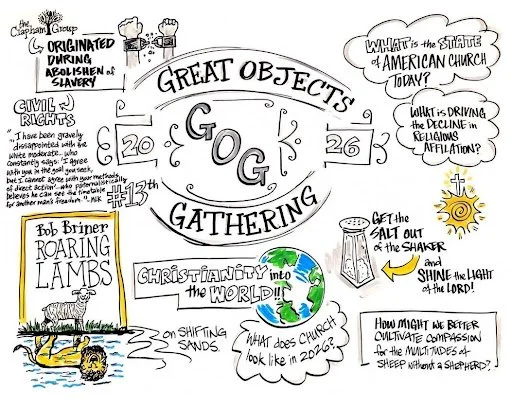
Graphics courtesy of Peter Durand of Alphachimp.
Session 1: Vibes and the Vanishing Church
We started with the hard questions. What is the state of the American church today? What’s driving the decline in religious affiliation? And how might we cultivate compassion for the multitudes who are “like sheep without a shepherd”?
One striking observation was the “death of nominalism.” People who once checked the box as “Christian (sort of)” now simply say “non-religious.” But when people leave, their spiritual need doesn’t go away. That void gets filled by something else: politics, materialism, self-help, pornography, shame, pseudo-science, mysticism, secularism, or a Christianity cut loose from biblical fundamentals.
Gen Z came up again and again. They are spiritually seeking but suspicious of institutions. They want the truth, they’re asking serious questions, and they have no interest in lukewarm faith.
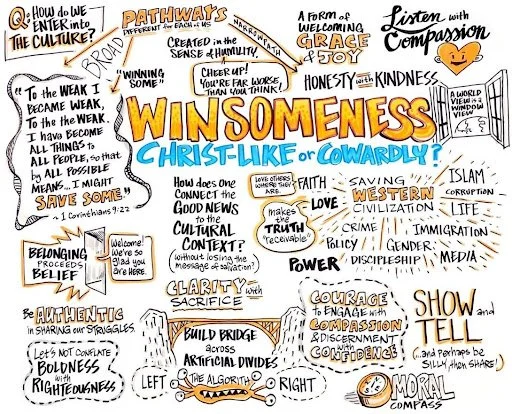
Session 2: Winsomeness — Christ-like or Cowardly?
This was probably our liveliest conversation. Is “winsomeness” a faithful way to engage the culture, or a way to avoid hard truths? We started with Paul in 1 Corinthians 9:22: “I have become all things to all people, that by all means I might save some.” The challenge was to connect the Good News to today’s cultural context without losing the message of salvation.
A few ideas stuck with me:
Belonging often comes before belief. “Welcome, we’re so glad you’re here” opens more doors than an argument.
Love makes truth receivable. Honesty with kindness. Clarity with sacrifice.
Don’t confuse boldness with righteousness. Being loud isn’t the same as being faithful.
Build bridges across artificial divides. We need to resist the left/right split the algorithm feeds us.
Be authentic about our own struggles, and engage with compassion, discernment, and confidence.
The hot-button topics are real: immigration, gender, life, crime, media, power, and the impulse to “save Western civilization.” The group kept coming back to loving people where they are.
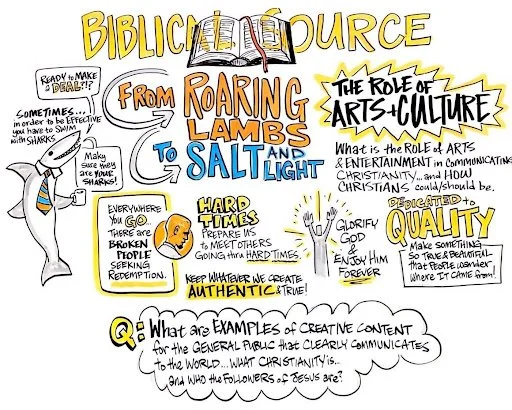
Session 3: From Roaring Lambs to Salt + Light — The Role of the Arts and Culture
This session is close to the heart of the Briner mission. What role do the arts and entertainment play in communicating Christianity, and how should Christians show up in those industries?
The conversation sounded a lot like Bob. Sometimes, to be effective, you have to swim with the sharks! Everywhere you go, there are broken people looking for redemption. The hard times we’ve been through prepare us to meet others in theirs. Whatever we create has to be authentic and true, and dedicated to quality. The goal is to make something so true and beautiful that people wonder where it came from.
We closed with a question I’d love your help answering: What are examples of creative work for the general public that clearly show the world what Christianity is and who the followers of Jesus are?
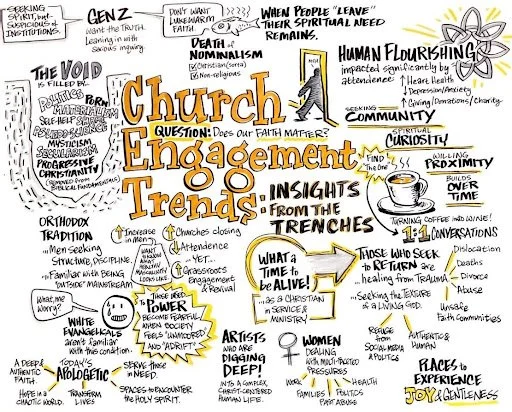
Session 4: Men, Women, and Church Attendance
The second morning brought some surprising trends. Churches are closing and overall attendance is down. Yet grassroots engagement and revival are growing, and more men are showing up. Many men want structure, discipline, and a picture of healthy masculinity, and some are finding it in the Orthodox tradition. Women, meanwhile, are carrying pressures on many fronts: work, family, health, politics, and sometimes past abuse.
Many of those coming back to church are healing from trauma. They’ve been through dislocation, death, divorce, abuse, or unsafe faith communities. They’re looking for “the texture of a living God,” a refuge from social media and politics, and places that are authentic, human, and marked by joy and gentleness.
There’s good news here too. Research continues to show that church attendance is linked to better heart health, less depression and anxiety, and more generosity. And people still come to faith one conversation at a time. One line from the room was “turning coffee into wine”: genuine, one-on-one relationships built over time.
Today’s apologetic, the room suggested, is a deep and authentic faith. It offers hope in a chaotic world, transforms lives, serves those in need, and creates space to encounter the Holy Spirit. As one board put it: What a time to be alive as a Christian in service and ministry!
Session 5: Where Do We Go from Here?
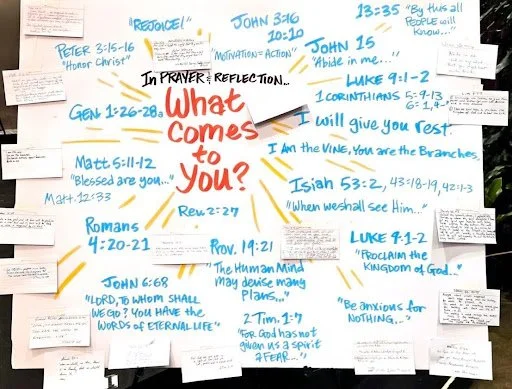
We didn’t end with action items. We ended in prayer and reflection, with a simple question: What comes to you? Attendees wrote down the Scriptures on their hearts and posted them on a shared board. It filled up quickly:
“Abide in me… I am the vine; you are the branches” (John 15)
“Lord, to whom shall we go? You have the words of eternal life” (John 6:68)
“By this all people will know that you are my disciples” (John 13:35)
“God has not given us a spirit of fear” (2 Timothy 1:7)
“Behold, I am doing a new thing” (Isaiah 43:18–19)
“Be anxious for nothing” (Philippians 4)
It was a fitting reminder that whatever the church looks like in 2026, it starts with abiding in Christ.
Worship from Isaac Wardell and The Porter’s Gate, and an evening performance by Sandra McCracken and Jazer Willis, carried us through both days. I’m grateful to the Clapham Group and Lipscomb University for hosting. I’m also grateful to you, because your support made it possible for The Briner Institute to be part of this conversation.
If any of this sparks a thought, especially an answer to that arts-and-culture question, I’d love to hear from you. Just reply to this email.
Stay tuned for more!